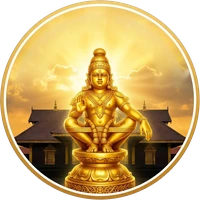

Swamiye Saranam Ayyappa
Shastha Thirukkalyanam
The divine wedding of Sri Dharma Shastha with Poorna Devi and Pushkala Devi, and the Sampradaya Bhajan tradition through which it is celebrated.
What Is Shastha Thirukkalyanam?
Shastha Thirukkalyanam (also called Shastha Kalyanam or Thrikkalyanam) is the ceremonial celebration of the marriage of Lord Dharma Shastha – Hariharaputra, the son of Shiva and Mohini (Vishnu) – with his two consorts, Poorna and Pushkala. It is performed as a devotional festival of song and ritual, modeled on the kalyana utsavams of Radha, Sita and Rukmini that are part of the South Indian bhajan tradition. Devotees do not merely watch the wedding: through the bhajans they take the roles of the bride's party, the groom's party, the messengers and the guests.
Significance
Shastha as the householder Lord. In Tamil Nadu and Keralam, Shastha (and his village form, Ayyanar) has long been worshipped as Poorna Pushkala Sametha – the Lord with his two consorts. The Puranas that tell of his incarnation, such as the Skanda, Padma and Brahmanda Puranas, praise him in this form. This is distinct from Ayyappa of Sabarimala, the avatara of Shastha who lived as the adopted son of the Pandalam king and remains a naishtika brahmachari. The Thirukkalyanam honors Shastha in his original, complete (moola) form.
Poorna and Pushkala as his Shaktis. Tradition explains the two consorts as the Lord's powers of will and action – Iccha Shakti and Kriya Shakti. Their union with Shastha represents the completeness of the Divine: will and action joined to the Lord who governs dharma.
The soul's union with God. Like every Thirukkalyanam, the wedding is also an image of the individual soul (the bride) being united with the Lord, by His grace and by its own devotion.
Blessings for devotees. The celebration is widely believed to bless families with harmony, prosperity and progeny, and to remove obstacles to marriage. At Aryankavu, many unmarried girls visit the temple during the Thrikkalyanam festival.
Community and dharma. Performed by a whole bhajan group with families taking part, it brings the community together around nama sankirtanam, in the spirit of the Shastha Preethi and Ayyappan Vilakku traditions.
Origin and Legends
The Puranic and folk accounts. Several versions exist, and they vary by region:
- Pushkala is said to be the daughter of King Palinja Varman of Nepal, who planned to sacrifice her in a ritual to gain immortality. She prayed to Shiva, who sent Shastha to rescue her, and Shastha married her.
- Poorna is said to be the daughter of King Pinchaka Varman, who ruled in the Kochi region. When the king was attacked by demons while hunting, Shastha saved him, and the grateful king offered Poorna in marriage.
- In this account, Palinja Varman was angered by the second marriage and cursed Shastha to be born as a human and live as a celibate – a story that links Shastha to the later Ayyappa avatara.
- Other versions: the Brahmanda Purana describes Poorna as the sister of Upendra, married to Shastha on Chitra Pournami; a Kanchipuram tradition makes her the daughter of King Shivapala; and the Shankara Samhita says both consorts arose from the eyes of the sage Satyapoorna.
Aryankavu
At the Aryankavu Shastha temple in Kollam district – one of the shrines traditionally said to have been installed by Parashurama – the Lord is worshipped with Pushkala Devi, a maiden of the Saurashtra community of Madurai. The story is that she traveled through the forest with her father, a silk merchant, fell in devotion to the Lord, and merged with Him. Every year the Thrikkalyanam is held there during the Mandalam season (around 10th Dhanu, in December), following Saurashtra wedding customs, preceded by the Pandiyan Mudippu (betrothal). Saurashtra families still come as the bride's people, bringing gifts for the bride. This Pushkala is generally understood as distinct from the original Poorna–Pushkala consorts.
The Bhajan-Based Celebration
The Thirukkalyanam as a sampradaya bhajan utsavam – the form most Ayyappa samajams follow today – was systematized in Chennai. Devotees of Villivakkam, who worshipped Kalyana Varada Shastha with Poorna and Pushkala, organized the procedure under the leadership of Sri R. Viswanatha Sarma. The Villivakkam Sri Ayyappa Bhajanai Sangam published the order of songs, stotras and wedding mantras as the Shastha Thirukkalyana Manjari in 1975, with a new edition in 2006.
Auspicious Days
Chitra Pournami (per the Brahmanda Purana), Panguni Uthiram (also observed as the day of Ayyappa's manifestation) and the Mandalam–Makaravilakku season are popular occasions. Many groups also hold it at the close of an annual Shastha Preethi or Ayyappa Utsavam.
How the Thirukkalyanam Is Performed
The exact order varies between groups. The outline below follows the Shastha Thirukkalyana Manjari and the general Dakshina Sampradaya kalyana utsavam pattern.
1. Preparation
- A decorated mandapam with the images or pictures of Shastha, Poorna and Pushkala; a separate swing (oonjal) for the Dolotsavam.
- Wedding items as for a traditional marriage: thirumangalyam, new vastrams, garlands, akshathai (turmeric rice), betel, fruits, sweets and kumkum.
- Ganapathi Puja, sankalpam, and the avahanam (invocation) of Shastha with Poorna and Pushkala.
2. Bhajan and Dolotsavam (Eve of the Wedding)
- The bhajan opens in the sampradaya order with Thodaya Mangalam, Guru Dhyanam and Guru Keerthanams.
- Namavalis and keerthanams on Shastha continue late into the night, ending with the Dolotsavam – the Lord rocked on the swing with lullaby songs.
3. Morning Rites and Unchavritti
- Morning rites and a procession with bhajan.
4. Songs of the Courtship (Dhoothu)
- Shastha Varavu Vendal – the plea for the Lord to come.
- Thozhi Vidu Dhoothu – the brides send a friend as messenger; the friend's reply; the replies and longing of Poorna and Pushkala.
- Kurathi Dhoothu / Kurathi Paatu – the fortune-teller who predicts the wedding.
- Pambu Kanni, Magudi and Kili Kanni – folk-style songs (snake-charmer, the parrot as messenger).
5. Arrival of the Bridegroom
- The Coming of Shastha songs, and the Lord's arrival at the wedding hall, welcomed with Shobhana Kummi and Shobhanam.
6. The Wedding Rituals
- Maalai Maatral – exchange of garlands.
- Shastha Kalyana Ashtapadi.
- Muthu Kuthuthal and the akshathai songs.
- Mangala Snanam (auspicious bath) and Thalandu Shobhanai.
- The Dharma Shastha Kalyana Choornikai, verses on Sri Poornambal and Sri Pushkalambal, and the offering of new vastrams.
- Pravaram – recital of the lineages of Poorna Devi and of Sri Hariharaputra.
- Kanyadanam – formal giving of the brides.
- Mangala Ashtakam, then Mangalya Dharana – tying of the thirumangalyam to the resounding call of Swamiye Saranam Ayyappa.
7. Conclusion
- Nalangu and festive songs (in many groups), Puja, Mangala Aarathi, the concluding Mangalam, and distribution of prasadam and the wedding feast (samaradhanai).
Significance of the Sampradaya Bhajans
What "sampradaya bhajan" means. In South India, Sampradaya Bhajan (the Dakshina Bharata Sampradaya Bhajan) is the systematic rendering of devotional songs by many composers in a fixed order called the paddhati. A sampradaya is the established, prescribed way of doing a sacred act; the bhajan is sung in that order so that the devotee receives its full benefit.
Why the Bhajans Matter in the Thirukkalyanam
- Nama sankirtanam as the way for Kali Yuga. The founding Gurus taught that singing the Lord's names is the surest path to liberation in this age. The Thirukkalyanam is, at heart, an extended nama sankirtanam.
- The songs are the ritual. Each stage of the wedding is enacted through song – the messengers, the fortune-teller, the arrival, the garlands, the Mangalya Dharana. Singing is how the community takes part in the wedding.
- Discipline and continuity. The fixed paddhati keeps the celebration the same across generations and places, so any devotee trained in it can join any group.
- Many languages, one devotion. The paddhati draws on Sanskrit, Tamil, Telugu, Marathi, Kannada and Malayalam songs, uniting devotees across regions.
- Inclusiveness. Everyone sings together; no one is merely an audience.
Who Authored the Tradition
The Sampradaya Bhajan paddhati. The tradition is attributed to a trinity of Gurus:
- Sri Bhagavan Nama Bodhendra Saraswathi Swamigal (Govindapuram)
- Sri Sridhara Venkatesa Ayyaval (Thiruvisanallur)
- Sri Marudanallur Sadguru Venkatarama Swamigal (Marudanallur Sadguru Swamigal)
It was Marudanallur Sadguru Swamigal who actually composed the order – the paddhati krama – by collecting songs of great devotees across India and arranging them. It was later enriched by Sri Pudukkottai Gopalakrishna Bhagavatar and Sri Krishna Premi.
The Shastha Thirukkalyanam paddhati. The order of songs and rituals specific to Shastha Kalyanam was systematized by the devotees of Villivakkam, Chennai, under Sri R. Viswanatha Sarma. It was published by the Villivakkam Sri Ayyappa Bhajanai Sangam as the Shastha Thirukkalyana Manjari (1975; revised 2006). An English translation by Sri P. R. Ramachander is widely circulated.
Swamiye Saranam Ayyappa