
Swamiye Saranam Ayyappa
Shastha Preethi
A traditional celebration to please Lord Shastha, with Vedic chanting, puja, 18 or more neivedyams, bhajans, the Varavu Paatu and a grand annadanam, held during the Mandalam season.
What Is Shastha Preethi?
Preethi means delight, or what pleases. Shastha Preethi is a celebration offered to please Lord Shastha, to thank Him and to seek His blessings, with Vedic chanting, puja, bhajans and a grand annadanam (community feast). It is a cherished tradition in Keralam and Tamil Nadu, where families and whole communities hold it, often during the Mandalam season.
Much of our worship is personal: a prayer at home, a vow kept quietly. Shastha Preethi is the opposite. It is devotion offered together, with families singing, praying and eating side by side, and devotees come asking for peace, protection, good health and strength on the spiritual path. Each region and family keeps its own customs for the day, but the heart of it is the same everywhere: a joyful offering of love to the Lord.
Who Is Dharma Shastha?
Lord Ayyappa is worshipped as Dharma Shastha, the protector and teacher of dharma, the right way to live. He is also Hariharaputra, the son of Hari and Hara: Lord Vishnu, as Mohini, and Lord Shiva. Devotees see in this birth the oneness of the Divine, beyond the forms we give it.
Shastha shrines have stood across Keralam and South India for centuries, and His worship has been kept alive in temple rituals, family observances, bhajan gatherings and the pilgrimage to Sabarimala. The qualities He stands for (self-control, compassion, humility and discipline) are the same ones a Shastha Preethi asks of those who take part.
A Short History
Shastha Preethi has its own long history, separate from Ayyappa puja and the Sabarimala yatra. Its home is traditionally said to be Kallidaikurichi, a village on the Thamirabarani river in Tirunelveli district, near the old border of the Chera and Pandya kingdoms. There the Karandhaiyar Palayam samooham, a community of eighteen agraharams, worshipped Lord Shastha at the village temple.
A story told there says that Lord Manikandan once came to the village in human form and asked an elderly couple for food. Pleased by their welcome, He made Himself one of their family, and devotion to Shastha in Kallidaikurichi is said to have begun with that family, the Kambankudi family.
About three hundred years ago, families of the samooham crossed the Western Ghats into Keralam to seek a new life, trusting that Lord Shastha would travel with them. They settled first between Mavelikkara and Kayamkulam, and then in Kochi, Paravur and Thiruvananthapuram. To them He was Paradesi Kavalan, the protector of those far from home. From these settlements the tradition spread through Palakkad, Thrissur and Ernakulam, and to Kanyakumari and Nagercoil, and today Shastha Preethis are held across India and abroad. The boatmen's Vanji Paatu, born on Keralam's rivers and backwaters when the families traveled by water, is still sung at some of them.
There is no single written text for the day; each samooham keeps its own customs. Traditionally a Shastha Preethi is held on a Saturday, with tall brass lamps lit for Lord Ganapathi, Lord Shastha at the center, and His attendant deities. The neivedyams include Chathachayam payasam, ellurundai and neiyappam, and the Varavu Paatu sung in welcome are attributed to the poet Manidasar, who lived some 150 to 200 years ago and is revered as the Guru of Shastha devotees.
This history is drawn, in our own words, from an article on the theory, text and practice of Shastha Preethi in South India by Sri V. Aravind Subramanyam of the Shri Maha Sasthru Seva Sangam, Coimbatore, with thanks.
The Day
Our Shastha Preethi brings together:
- Vedic chanting by the priests, to invoke the Lord's presence and blessings.
- Puja to Lord Shastha, with archana and offerings.
- 18 or more neivedyams, our own tradition (see below).
- Bhajans in praise of Lord Ayyappa.
- The Varavu Paatu, the song of His arrival (see below).
- Annadanam, the grand feast, shared by all as prasadam.
Depending on the family or community, a Shastha Preethi may also begin with a Ganapathi Homam, so that the day goes ahead without obstacles, and a Kalasha Puja, in which sacred water in a kalasham is sanctified with mantras and later used to bathe the Lord. Many celebrations also include an Abhishekam and Alankaram, and a ceremonial welcome of the Lord to the beat of the Chenda Melam.
Our 18 Neivedyams
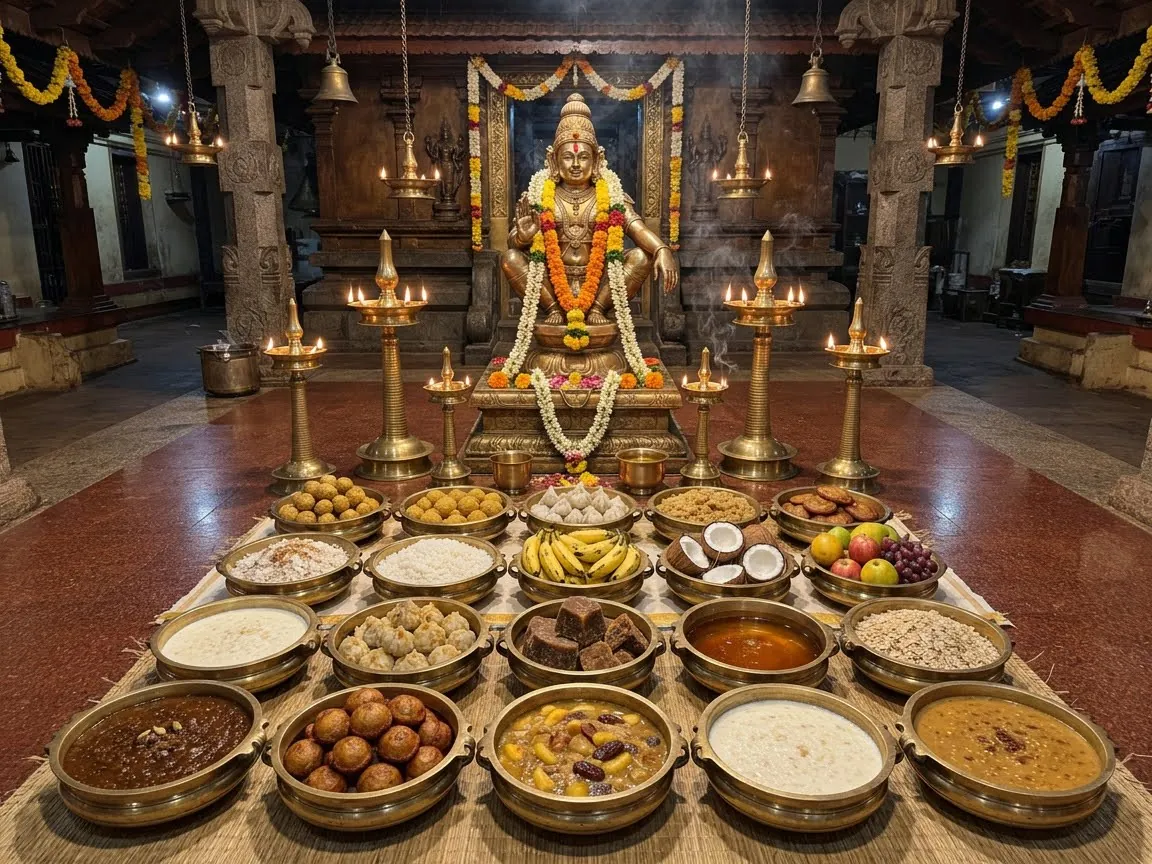
In the tradition we follow at Ayyappa Samaaj, Lord Sri Dharma Shastha is offered 18 or more neivedyams (food offerings) at Shastha Preethi.
The tradition held even in the Covid years, when the temple was closed. We began with just 2 neivedyams, and the offerings grew until once again there were 18 and more. We take it as a sign that Swami wants His 18 neivedyams, year after year.
The neivedyams are presented to the Lord in brass urulis (wide, round offering vessels) ordered specially for Him, and the main neivedyams are offered in silver urulis.
Abhishekam and Alankaram
In the Abhishekam, the Lord is bathed with sacred offerings while the priests chant and devotees pray. It is an act of reverence and of purification: as the deity is bathed, devotees ask that their own minds be made clean too.
Then comes the Alankaram, when the Lord is dressed in new garments and adorned with ornaments, flowers and garlands. The curtain opens for darshan, and for many devotees this first sight of the decorated Lord is the most moving moment of the day.
The Varavu Paatu and the Chenda Melam
Song is at the heart of a Shastha Preethi. The traditional songs sung for the Lord on this day, the Shastha Preethi Paatu, praise His qualities, retell His story and pour out the devotee's surrender, in words that ordinary speech could not carry. Singing His names again and again, together, quiets the mind and draws the whole gathering into one voice.
A highlight of the day is the Varavu Paatu, the "song of arrival," which welcomes Lord Ayyappa through traditional devotional songs telling the story of His life and His journey to Sabarimala. Sung in the old folk style, it is a tradition rarely heard outside Keralam, and for many devotees here it is a rare chance to hear it.
In Keralam, the Lord's welcome is often led by the Chenda Melam, the thundering ensemble of the chenda, a cylindrical drum heard at every great temple festival there. Its rising rhythm announces that the Lord has arrived.
Annadanam
Feeding others is among the highest offerings in our tradition, and Lord Ayyappa is praised as Annadana Prabhu, the Lord of annadanam, in the Saranam Ghosham. At Shastha Preethi, devotees seek the Lord's blessings and share in the prasadam together, continuing a cherished tradition from Keralam and Tamil Nadu.
Everyone eats the same food, seated together as guests of the Lord, and those who cook and serve count it as their own offering. Volunteering at the annadanam is one of the simplest ways to take part.
In the Mandalam Season
Shastha Preethi is often held during the Mandalam season, the 41 days when devotees keep the Ayyappa vratam of prayer, simple living and self-control. The two complete each other: the vratam is inward, a quiet discipline that changes the one who keeps it, while Shastha Preethi turns that devotion outward, into song, service and a meal shared with the whole community.
Why It Matters
For families far from Keralam and Tamil Nadu, Shastha Preethi is a living classroom. Children hear the songs, watch the rituals, help serve the meal and learn the customs their grandparents grew up with, and so the tradition passes on to the next generation.
It also binds a community together. Praying, singing and eating side by side builds the sense of belonging, respect and care for one another that Lord Shastha's own teaching asks of us.
Taking Part
This year's date, place and any registration are on Upcoming Events and our Calendar as soon as they are set. To hear about it first, join the mailing list.
Swamiye Saranam Ayyappa